Same-Day Parts: Tungaloy CNC Machining vs. Renting a 3D Printer
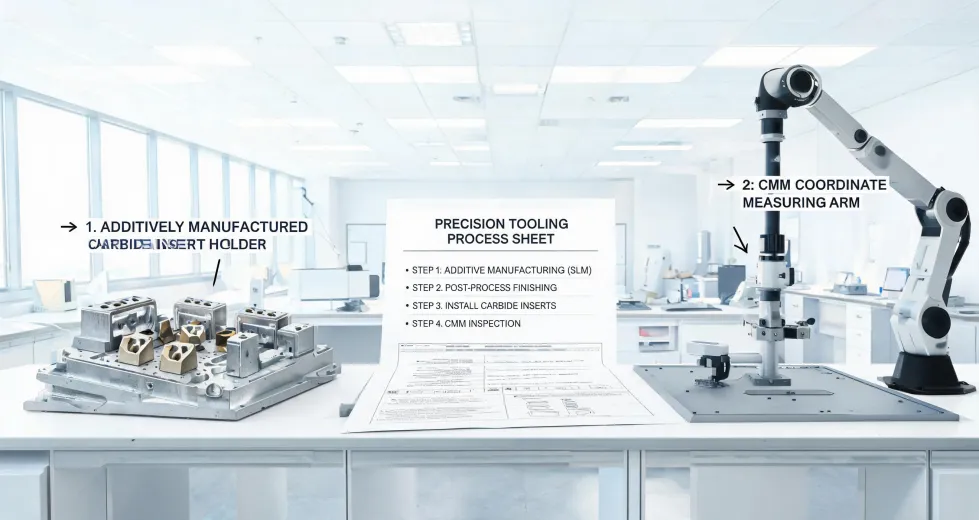
When the call comes in at 9:15 AM saying a line is down and the part is custom, you've got two realistic paths: machine it or print it. This article is a head-to-head comparison of those paths—CNC machining with Tungaloy cutting tools versus renting a 3D printer.
Quick background on me: I'm a production lead at a custom machining shop. I've handled 200+ rush orders in nine years, including same-day turnarounds for food processing, medical device, and automation clients. Here's the framework I use to decide. I think it'll shorten your "uh, let me think" pause from five hours to five minutes.
What We're Actually Comparing
Both approaches can produce a physical part in a day. That's where the similarity ends.
We're comparing on four axes:
- Time to first part — including the hidden setup hours nobody quotes
- Material and functional integrity — will the part actually do the job?
- Real cost structure — not just the invoice, but the cost per usable part
- Failure modes under deadline pressure — because at 3 PM on a same-day job, failures have very different consequences
Dimension 1: Time to First Part
CNC Machining with Tungaloy Tooling
Say the part is a steel bracket, roughly 80 × 50 × 6 mm. Normal lead time is a week. You have until 5 PM.
Here's the realistic timeline on a high-speed 5-axis CNC milling machine:
- CAM programming: 1 to 2 hours
- Fixture setup: 30 to 45 minutes
- Tool selection and presetting: 15 to 20 minutes
- First article cutting: 10 to 25 minutes
Total: about 2.5 to 3.5 hours to the first verified part. Subsequent parts follow at cycle time. That leaves hours of buffer before shipping cutoff.
The high-speed 5-axis part matters more than people give it credit for. Because the machine indexes the workpiece and cuts multiple faces in a single setup, you lose those awkward "second operation" steps. And with Tungaloy high-feed end mills, you're taking heavy depths of cut at spindle speeds older CNC operators simply didn't trust. The tooling is the enabler—a machine is only as fast as its inserts allow it to be.
Renting a 3D Printer
Can you rent 3D printers? Yes, absolutely. Industrial FDM and resin units are available by the day across the US. But the question is rarely "can you" — it's "what's the actual time-to-part?"
Realistic timeline for a printer rental:
- Delivery and setup: 2 to 5 hours (the "printer is arriving at 11" problem)
- File repair and slicing: 30 to 60 minutes
- Printing: 3 to 15 hours for the same bracket, depending on layer height
Even when the part comes off the bed, it isn't done. Support removal, sanding, maybe acetone smoothing for ABS. Another hour or two.
So for a single bracket, machining is almost always faster. The scenario where the printer wins? When you need a small plastic part with simple geometry and the machine is already running another job. Maybe.
Dimension 2: Material and Functional Integrity
From the outside, a 3D-printed bracket looks like a bracket. The reality is that most printed materials are anisotropic—strong in the XY plane, weak in the Z. FDM parts can delaminate under shear load, and even a perfectly printed part is limited by its heat deflection temperature. PLA softens in a car on a summer day. That's not speculation.
There's a reason machining tolerance standards exist. ISO 2768-m, the standard general tolerance for machined parts, allows about ±0.1 mm on dimensions up to 30 mm. A Tungaloy-equipped CNC hits that easily—and with a decent insert, ±0.01 mm is realistic.
A 3D printer, freshly calibrated, might hold ±0.2 mm on a good day. And if the part warps—which it will, if it has a wide base—you're out of tolerance before you even remove the supports.
It's tempting to think "it's just a fixture, close enough works." But close enough has a habit of breaking at the worst possible moment. Usually while the client is watching.
Dimension 3: Real Cost Structure
Let's talk money. Not the sticker-price version.
CNC machining, typical shop math:
- Shop rate: $90 to $150 per hour. At 3 hours: $270 to $450.
- Insert cost: a Tungaloy CNMG insert is $8 to $15. You might burn one edge on this job. Call it $5.
- The tooling stays in your cabinet. The cost per part trends to zero on repeat orders.
3D printer rental, typical:
- Daily rental: $200 to $500 based on public listings, early 2025
- Material: $30 to $80 per kg. A 200-gram bracket: $6 to $16.
- Delivery and setup: $50 to $150.
- Failed prints: the hidden line item. If a 6-hour print warps at hour 5, you're behind a day with nothing to show.
In March 2024, a client insisted on the 3D printer route for 12 fixture parts. Printer rental plus materials came to roughly $680. Maybe $640, I'd have to check the invoice. The first print failed from a layer shift around hour 4. We couldn't restart because the rental had a job queue conflict. We ended up machining the parts anyway—3.5 hours on a turning center with Tungaloy turning tools, $420 all-in. The printed parts never made it into service.
That's a lesson I took personally.
Dimension 4: Failure Modes Under Deadline Pressure
This is the axis nobody compares, but it's the one that matters most for rush orders.
CNC Failure Modes
CNC failures are visible and fast:
- A programming error shows up at first article inspection. You fix it. Cost: 30 minutes.
- Tool chatter appears on the machined surface immediately. You adjust speed and re-cut. Cost: 20 minutes.
- Machine downtime happens, but you have another machine. And the failure is usually diagnosable.
When a CNC fails, it fails loudly and early. You catch it. You recover.
3D Printer Failure Modes
Printer failures are silent and late:
- Layer shift: begins at hour 2, becomes visible at hour 6. Total loss.
- Warping: first layer lifted at minute 10, discovered when the nozzle drags through it at hour 1.
- Nozzle clog on a rental machine: you don't know the maintenance history, and you don't have spare nozzles. No magic fix.
Here's where my hindsight kicks in. In September 2023, a client needed 40 check fixtures for a factory startup. I chose to rent a printer to keep our machining schedule clear. The rental arrived at 10 AM. First print failed. Restarted at 2 PM. We went home at 6. It failed again around 8 PM—we found out at 6 AM the next morning. Parts shipped three days late. We paid an $850 penalty.
If I could redo that decision, I'd have put the fixtures on the CNC from the start. At the time, the printer looked like the safe option because it didn't block our machines. I was wrong. Not because the printer is unreliable, but because its failure modes are invisible until it's already wasted your day.
A Third Option Worth Mentioning
If the emergency part is sheet metal, neither a 5-axis mill nor a 3D printer is the fastest answer. A press brake with ESA controller can cut and form a bracket in minutes. Setup is measured in single digits. In my experience, shops with a press brake with ESA controller win these rush quotes because they can promise a bend in the time it takes to load the program.
Keep it in mind. It's often forgotten in the machining-versus-printing conversation.
When to Choose What
Use a Tungaloy-equipped CNC machine when:
- The part is metal, structural, or sees heat
- Tolerance is tighter than ±0.1 mm
- You need multiple identical parts by tomorrow morning
- The part is cylindrical—a shaft, pin, or bushing. Tungaloy turning tools on a lathe will beat both a mill and a printer on cycle time.
Rent a 3D printer when:
- The part is plastic, non-structural, and small enough to print in under 3 hours
- You're iterating on a design and will likely discard the first version
- You have lead time measured in days, not hours
- You need a visual model, not a functional replacement
Use a press brake when:
- The part is sheet metal with a bend
- You need a one-off bracket, panel, or cover
Final Word
Look, I'm not saying 3D printers are useless. They have real jobs: prototypes, no-load fixtures, design reviews. But in a same-day emergency, the honest math says: if the part has to work, machine it. And if it's round, put it on a lathe with a good Tungaloy insert before you overthink it.
Rush orders don't forgive slow decisions. You need to be right the first time, because the second time costs you the client.

Ana Kovacevic
Ana Kovacevic is an independent CNC milling and five-axis machining analyst covering precision parts, machining centers, workholding, and complex surface strategies. She applies ISO 1101 geometrical tolerancing while examining datum schemes, tool reach, setup count, spindle load, surface roughness, and inspection access before accepting tight requirements. Her technical guides help design and manufacturing teams improve DFM decisions, compare machine capability, and control dimensional risk from prototype through production.