Tungaloy Catalog, OMTech CO2 Laser Cutter, or SLS/SLA? A Rush-Order Comparison
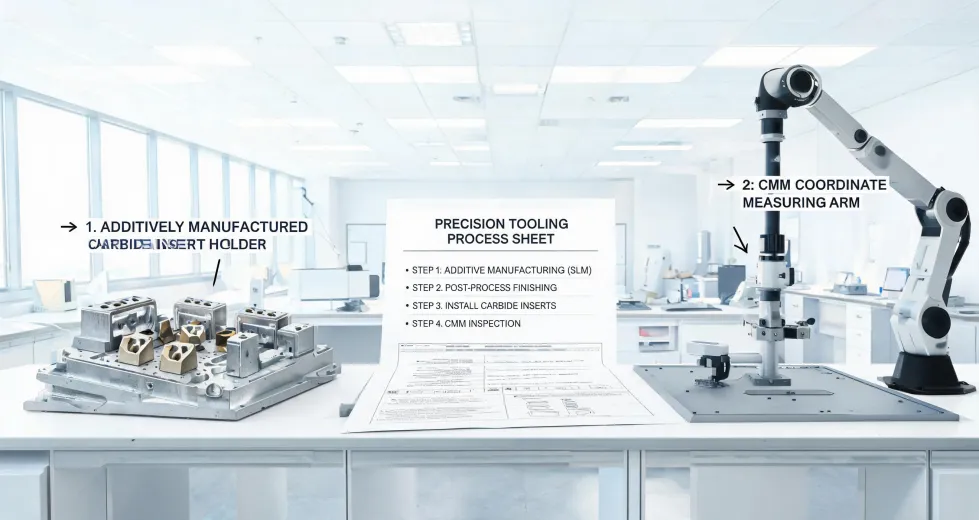
I'm the person who answers the phone when a client says 'it can't be late.' Over the past five years, I've coordinated more than 200 rush orders, including a 36-hour turnaround for a stainless steel flange in March 2024. During that time, I've learned that most 'best technology' articles are written by people who don't need the part on Thursday. This one is written by someone who does.
What I Compare Before Choosing
Before any brand talk, I look at the part print and ask four questions:
- What material does the part need to be?
- What tolerance does it actually need?
- How many pieces do I need to deliver?
- Does surface finish matter, or is function enough?
These questions usually point to one of three routes: CNC machining with Tungaloy cutting tools, an OMTech CO2 laser cutter, or 3D printing. In that order of familiarity for me.
Option 1: CNC Machining with Tungaloy Cutting Tools
When the part is metal and the tolerance is tight, CNC machining is the safety net. The Tungaloy catalog gives me the technical foundation for that route.
I keep a printed version of the Tungaloy catalog in the office. It covers turning tools, milling cutters, boring bars, tool holders, and insert grades for common and not-so-common workpiece materials. According to the Tungaloy catalog (tungaloy.com) as of early 2025, the range is broad enough that I rarely need to run across the street to another supplier. That consistency matters when I'm quoting an urgent job and cannot wait for a special order.
In a real emergency, Tungaloy cutting tools help me get from 'we have a problem' to 'the spindle is turning' faster. A Tungaloy insert change takes minutes. A holder can be swapped out without touching the machine offsets if the setup is standardized. That might sound boring, but when a deadline is in hours, boring is good.
The catch is that CNC machining requires a machine, a setup, and a person who knows what they're doing. It's not a one-button process. But for stainless flanges, hardened steel shafts, and the possibility of a 0.0005 inch bore, it's often the only realistic option.
Option 2: The OMTech CO2 Laser Cutter
For thin, flat, non-reflective materials, the OMTech CO2 laser cutter is hard to beat. I've used one for acrylic, plywood, MDF, and cutting gaskets out of thin sheet. It's fast, quiet, and doesn't make physical contact with the material.
I'll admit, I was skeptical about the OMTech CO2 laser cutter when it arrived. The first time we cut a complex acrylic panel, I changed the job geometry three times in the laser software and still had finished parts in under an hour. A router with the same part would have required toolpath changes, clamps, and a much louder afternoon.
But the edge condition is the catch. A CO2 laser burns as it cuts. On thin acrylic and wood, that's usually fine. On a 3 mm steel plate, you get a heat-affected zone, a tapered edge, and occasionally a compromised material structure. If that doesn't matter for the part, fantastic. If it does, you need one of the alternatives to CO2 laser.
Alternatives to CO2 Laser: When I Don't Grab the OMTech
I get asked about alternatives to CO2 laser more and more. The question usually comes from a shop owner who bought a laser cutter for metal and discovered its limits. Or from someone cutting parts that end up with burnt corners.
My short list of alternatives to CO2 laser:
- CNC machining with Tungaloy cutting tools for metal parts with real tolerances
- Waterjet cutting for thick metal and cold-cut edges (if the shop has one)
- 3D printing for complex 3D shapes, especially when no material removal is ideal
- Traditional plasma cutting when edge quality is not critical but thickness is large
Notice I'm not saying 'use a fiber laser.' A fiber laser is another alternative, but it's a bigger investment. For the average buyer comparing an OMTech CO2 laser cutter against a CNC machine, the practical choice comes down to how often you cut thin non-metals versus how often you need precision metal features.
Option 3: SLS vs SLA 3D Printing
Additive is the third route. And here, the most common comparison people ask about is SLS vs SLA 3D printing.
SLS is selective laser sintering. It fuses nylon powder, usually PA12, with a laser. The big win is that SLS doesn't need supports—the powder holds the part. That makes it excellent for internal channels, clips, and functional brackets.
SLA is stereolithography. It cures liquid resin with a UV laser. SLA produces smoother surfaces and finer details. The downside is that supports are required, and the post-processing can eat your timeline.
The surprising thing I learned is that SLS vs SLA 3D printing is not simply about accuracy. It's about labor. For one single small part, SLA can be faster. For 20 identical functional parts, SLS almost always wins because nobody spends a day removing supports, sanding, and curing.
Last quarter, we had to deliver 28 jigs. The quote left us two days. SLS printed them overnight and we shipped after a quick inspection. SLA would have needed supports in every tapped hole, and we'd still have been cleaning resin on the morning of delivery.
CNC vs CO2 Laser vs SLS/SLA: The Dimensions That Decide
I don't compare machines by asking which one has the shiniest YouTube video. I compare them on four dimensions that directly affect whether I make a deadline.
Material and Thickness
Tungaloy cutting tools on a CNC machine handle metal alloys, hardened steel, cast iron, and more. An OMTech CO2 laser cutter handles thin, flat, non-reflective materials. SLS and SLA handle polymers, not metal (unless you go into metal 3D printing, which is a separate world). For a 20 mm aluminum block, laser and polymer printing are both out. CNC is in.
Precision and Repeatability
If the part has to fit a bearing or a mating shaft, I trust CNC and Tungaloy cutting tools the most. A boring bar in a rigid lathe can hold tolerances that lasers and 3D printers never get near. SLA can produce beautiful, detailed dimensions on a bench, but resin can warp with heat and post-cure. SLS parts are strong, but the surface is structured and slightly porous. CO2 laser has a spot size and a heat-affected zone. So the ranking for precision, on average, is CNC, then SLA, then SLS, then CO2 laser for edge-critical work. That's not a universal law—lasers can cut very precisely on thin materials, and some SLA parts hold shockingly tight numbers. It's just the order I use when the pressure is on.
Lead Time, Batch Size, and Labor
This is where my opinion changed. Years ago, I thought SLA was the obvious additive choice for prototypes. Then I watched support removal become a project itself. Now my rule of thumb is:
- CO2 laser: fastest for flat 2D profiles up to a few dozen pieces.
- CNC: slowest to start, fastest overall once the tool is in the holder.
- SLS: overnight functional parts in batches, no support removal.
- SLA: fast for one intricate visual part, surprisingly slow for 20 with supports.
Total Cost, Not Quote Price
The machine cost is one thing. Operating cost is another. Tungaloy inserts cost money, but predictable tool life is worth more to me than the cheapest insert from an unknown supplier. A CO2 laser has tube replacement, gas, and fumes. SLA has resin, supports, and cleaning alcohol. SLS has expensive powder, but the labor savings can outweigh it. When I cost a rush job, I include every hour. Labor is usually the hidden cost that turns a 'cheap' process into the expensive one.
What I'd Choose Today
Because I'm a practical buyer, not a brand evangelist, here's how I'd decide right now:
- Metal bracket with tapped holes, 50 pieces: CNC with Tungaloy cutting tools.
- Acrylic sign with cutouts, one-off: OMTech CO2 laser cutter.
- Functional nylon prototype with snap fits: SLS, because supports would be a disaster.
- Small detailed model for a client review: SLA.
- Thin steel gasket with a simple contour: CO2 laser if the material is under 1 mm, CNC if it's thicker.
If you're still undecided, ask what happens when the first batch has an error. With CNC, I can adjust the tool offset and make another part immediately. With CO2 laser, I can resend the file and cut it again. With 3D printing, I can restart the build, but I might need the entire build time again. That's a risk no one talks about enough.
Bottom Line
Efficiency is the real competitive advantage. Not because automation is trendy, but because the shop that can switch between Tungaloy cutting tools, a laser cutter, and SLS/SLA without losing the deadline wins the next order.
This was accurate as of early 2025. The Tungaloy catalog changes, OMTech updates its product line, and 3D printer prices keep moving. Verify current specs before you buy a machine or quote a customer.

Ana Kovacevic
Ana Kovacevic is an independent CNC milling and five-axis machining analyst covering precision parts, machining centers, workholding, and complex surface strategies. She applies ISO 1101 geometrical tolerancing while examining datum schemes, tool reach, setup count, spindle load, surface roughness, and inspection access before accepting tight requirements. Her technical guides help design and manufacturing teams improve DFM decisions, compare machine capability, and control dimensional risk from prototype through production.