Tungaloy Catalog vs. Compatible Tooling: A Buyer's Comparison That Saves Money and Reputation
I've been handling machining orders for nine years. I've personally made and documented 14 significant mistakes, totaling roughly $26,000 in wasted budget. The one that forced me to change came in September 2022.
A vendor offered a "Tungaloy-compatible" boring bar kit at 38% below list. The Tungaloy logo on the shank looked almost right, but not exactly right. At least, that's what I told myself. What I mean is, I wanted the discount more than I wanted the evidence. I approved the order. On the third job, one of those bars deflected and scratched six parts to scrap. The cost of replacing those six parts came to $1,180, and the schedule delay was a week.
That was the trigger. Since then, I compare two types of sources before every tooling purchase: authorized Tungaloy distribution, and the aftermarket/compatible market that often shows up in packages from CNC turning machine suppliers.
The Comparison Framework
This comparison isn't about brand loyalty. It's about risk. I look at three dimensions:
- Catalog traceability — can I find this exact item in the Tungaloy catalog?
- Application support — can the supplier provide the engineering data I need?
- Total cost per finished part — what does the tool actually cost when I include scrap, rework, and downtime?
1. Catalog Traceability: Tungaloy Catalog vs. Vague Model Numbers
Every real Tungaloy holder has a catalog number that points to a specification: geometry, dimensions, coating, clamping, torque, cutting data. That's the biggest practical advantage of buying through a controlled channel.
When I compared the "compatible" kit against the Tungaloy catalog, I couldn't find the number. It was close to an existing Tungaloy number, but two letters were different. The logo had the same issue: the font weight on the G was heavier than the official Tungaloy logo, and the red was too orange. Take 30 seconds to compare the Tungaloy logo and catalog number. Professional color tolerance for brand-critical colors is usually Delta E under 2 (Pantone Color Matching System guidelines). If the color is visibly outside that, treat it as a red flag. That detail alone probably didn't cause the failure, but it meant the product was outside Tungaloy's quality chain.
2. Application Support: Published Data vs. Friendly Sales Voice
The aftermarket supplier had the best phone manners I've ever dealt with. They answered fast, used my name, and promised to "make it right." That was the problem: I didn't need promises, I needed data.
When I asked for recommended cutting data for an insert at 0.15 mm/rev, they went quiet for two days. The authorized Tungaloy channel sent me the relevant page from the Tungaloy catalog within minutes, plus a warning about the tool's coolant pressure limit. That's not intellectual property. That's application support.
The counterintuitive conclusion here is that the cheaper supplier was not lazy or dumb. They just didn't have the depth. For a simple job, both options were fine. For a harder job, the missing data was the difference between a good part and a scrap bin.
3. Total Cost: Sticker Price vs. Cost Per Finished Part
My second mistake was comparing the purchase price instead of the total cost. A "Tungaloy-equivalent" boring bar at around $68, versus $110 for the genuine item, looks like a $42 win. Subtract one scrapped part from that calculation and it's no longer a win.
A single scrapped part can eat $200 in material and labor before you count the delay. If any part of that delay pushes you past a customer's deadline, the cost multiplies. I don't have a perfect formula, but I now know the question to ask: what does this tool cost per finished part, not per unit?
That's why I ask CNC turning machine suppliers to itemize any tooling package they quote. If the "free starter kit" contains aftermarket holders, I want to know before signing. A free tool that costs you a customer is not free.
A Side Note: What Does Canelos VMC Stand For?
This may seem off-topic, but it's the same lesson. A customer's engineer once asked, "What does Canelos VMC stand for?" I gave a vague answer about a vertical milling center and hoped nobody would follow up. The truth: VMC means Vertical Machining Center. Canelos is a machine brand. The phrase is brand plus machine type, not a secret acronym.
I should have said "I don't know" and looked it up. It took two minutes. With tooling, the rule is identical: if you see a model number that isn't in the Tungaloy catalog, don't guess. Look it up.
What a Montreal 3D Printing Service Taught Me About Perception
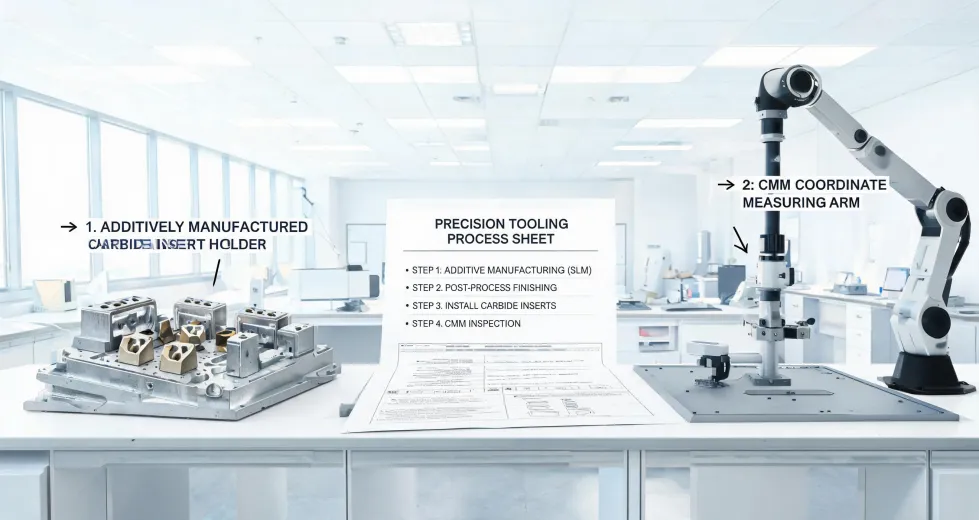
After the failed batch, I set up a visual check system. We photographed each genuine tool, marked the catalog number, and made a comparison sheet. Then we went further and used a Montreal 3D printing service to print color-coded inserts for every drawer in our tool chest. Each insert has the exact Tungaloy catalog number embossed on it.
The 3D printing service was not about looking cool. It was about making the right thing obvious. If a tool is missing or a wrong holder is sitting in the drawer, it shows in two seconds. Visitors see the order too. I should add that point: in B2B, the customer's first impression often happens before they see a part. A tidy, labeled toolroom tells the same story as a clean finish.
So Which Should You Choose?
I won't tell you to avoid all aftermarket tooling. That would be a lazy answer, and I've found a few honest aftermarket products that perform well. But I will tell you not to buy anything that pretends to be Tungaloy. If a product has a fake Tungaloy logo but no matching catalog number, it isn't a clever budget buy. It's a counterfeit.
- Choose genuine Tungaloy tooling when the part is customer-facing, tolerance is tight, or the operation is high-volume. The documented application data is worth the cost.
- Consider an honest aftermarket brand only for non-critical work, one-off repairs, or a geometry that doesn't exist in the Tungaloy catalog. And even then, test it on scrap before production.
- If the source can't produce a Tungaloy catalog number, don't trust the word "equivalent."
The Bottom Line: Quality Is Part of Your Brand
The phrase "quality perception" sounds soft, but it isn't. A customer who receives parts with uneven finish won't file a complaint; they will simply call someone else next time. The parts you ship are the only evidence they have of how careful you are.
Since I started this comparison process, we've caught 47 potential errors in 18 months. Most were small: wrong insert, wrong coating, missing torque spec. None was a surprise. I no longer trust my memory for this part of the job, and I don't expect you to either.
A $42 discount isn't worth the phone call I had to make after those six scrap parts. If you're buying tooling for a CNC turning machine, take the extra ten minutes to check the Tungaloy catalog and the logo. Future you will have to explain the difference to a customer.

Ana Kovacevic
Ana Kovacevic is an independent CNC milling and five-axis machining analyst covering precision parts, machining centers, workholding, and complex surface strategies. She applies ISO 1101 geometrical tolerancing while examining datum schemes, tool reach, setup count, spindle load, surface roughness, and inspection access before accepting tight requirements. Her technical guides help design and manufacturing teams improve DFM decisions, compare machine capability, and control dimensional risk from prototype through production.