Tungaloy Milling Tools: A Cost Controller's Perspective on Predictability, Portal Login, and Total Cost
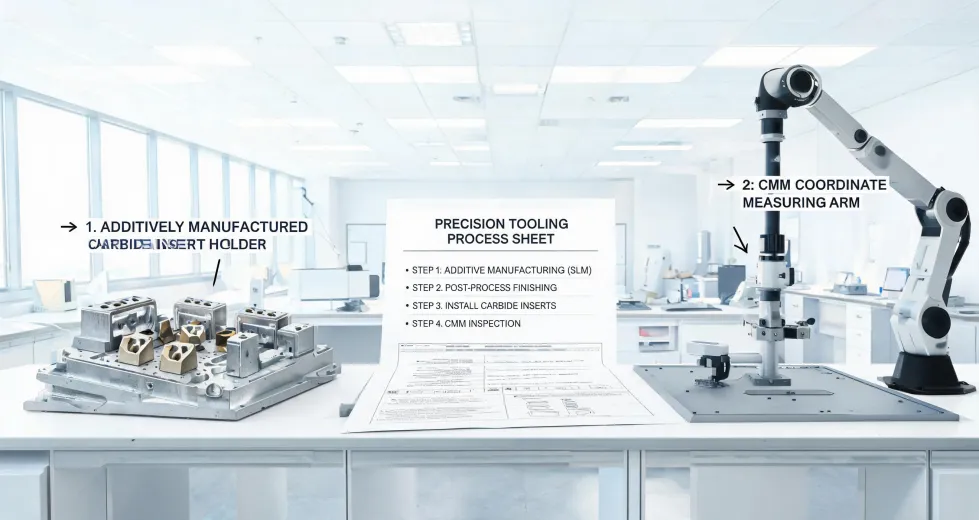
After seven years of buying cutting tools for a 35-person job shop, I've arrived at an awkward conclusion: Tungaloy is the brand I'd build a tooling budget around — not because it's the flashiest tooling on the market, but because it's the most predictable. In 2024, when I stopped looking at insert prices and started tracking per-part tooling cost, moving our high-feed and face-milling work to Tungaloy indexable cutters cut per-part cost by roughly 18%.
Tungaloy is the most predictable tooling brand I've bought in seven years, and predictability matters more than peak performance. If you remember one thing from this, remember that.
Before you call this a vendor testimonial: I don't work for the brand. I'm the person who asks why things cost more, and the spreadsheets live in my inbox.
Why you'd listen to me
I manage procurement for a 35-person custom machining company. For seven years, I've managed our tooling and consumables budget — roughly $850,000 a year — negotiated with 15+ vendors, and documented every order in our cost tracking system. Every one. Including the box of inserts I ordered in a hurry once that didn't fit the holder I assumed they'd fit. Still annoys me.
When I audited our 2023 spending, I found that 12% of our budget overruns came from one pattern: insert-batch inconsistency. Same insert, same box, different behavior from batch to batch. Machinists adapted mid-run, feeds got pulled back, cycle times stretched. The problems rarely showed up as a single scrap charge. They scattered through labor hours and missed delivery dates.
What Tungaloy milling actually gives you
We've standardized on Tungaloy for indexable milling, mainly the TungSixFeed series for high-feed roughing and Dodeka face mills for flat-surface work. I'll leave the edge-geometry arguments to application engineers. I track what shows up in cost data. Grade selection is mechanical, since Tungaloy organizes the chart by ISO 513 material groups — P, M, K, N, S, H — so picking a starting point is pretty painless. The brand also covers boring bars, turning tools, and toolholders; milling is just where our numbers improved first.
Edge-life consistency is the real feature. When inserts vary, running a job shop turns into whack-a-mole. You compensate, you slow the machine down, you scrap a part here and there. Tungaloy inserts, in our experience, are basically the same from batch to batch. Boring. And boring is exactly what you want when you've quoted 600 parts and the machine can't take a day off.
Concrete example from Q2 2024. A 600-part run of 1018 steel brackets. The alternative supplier quoted $1,780 for the tooling package; Tungaloy came in at $2,140. Any procurement person would lean toward the cheaper quote. I almost did, until I checked the recommended cutting data and edge-life claims. The alternative insert ran about 20% shorter edge life at equivalent parameters. What that meant in practice:
- More insert indexes, and each one is a setup interruption plus a chip restart
- More time at the inspection station, catching parts that should have been fine
- A slow drip of scrap at $4.20 a part
- An $85/hr loaded shop rate that does not pause while you fix a problem
Run the numbers over the full lot and the 'cheaper' package ended up costing about $1,100 more than the Tungaloy one. Not because Tungaloy tools are magical. Because the other quote looked great at the bottom line and worse everywhere else.
That lesson came from an earlier job, where the cheap option failed on the first production lot and we redid the parts at full cost — $4,200, with a shrug from the supplier. The re-run alone wiped out any savings from the initial purchase.
Look, I'm not saying budget tooling is always bad. I'm saying it's riskier, and the risk always lands on your floor — not on the quote.
Do yourself a favor: set up the Tungaloy login early
If you searched 'tungaloy login' and landed here while a quoting deadline is ticking, you're doing exactly what I did the first time. The advice is annoyingly simple: register before you need it. It took me ten minutes, and it killed the two-day email loop I used to live in.
The customer portal is where the useful stuff lives: current catalogs, grade reference charts, and 3D models in STEP format that drop straight into CAM software. Those models are built to ISO 13399, the standard that governs cutting tool data representation — which is a fancy way of saying what you download actually matches what your CAM system expects. No 'close enough' geometry, no surprise tool paths.
I once asked my assistant to 'grab the Tungaloy data' for a quote. Same words, wrong thing — she pulled the 2022 brochure from the shared drive. We would have quoted cycle times we couldn't hit. Caught it before cutting, because checking the current catalog in the portal takes five minutes. Five minutes of verification beats five days of correction, every time.
One more portal tip: order from the item codes in the portal, not from memory. I ordered a toolholder from memory once. Wrong version. Worse than expected. My fault entirely, and probably a story for a different article.
The laser engraver detour (and what it has to do with tooling)
More than you'd think, which is why I'm including it here. Last year my boss asked me to evaluate a desktop CO2 laser engraver for marking and light engraving. Customers kept requesting logos and serial numbers, and outsourcing that work had become a monthly nuisance.
I read a pile of K40+ desktop CO2 laser engraver reviews during that project. In procurement terms, the K40+ is a ~$350 appliance with ~$150 of hidden requirements and hobby-grade safety. The reviews told me what I needed to know: poor interlock protection, dated control software, air assist effectively mandatory, and support that is closer to a forum thread than a phone number. Not ideal, but workable — if you know what you're getting into.
By comparison, the xTool S1 20W laser cutter costs about double. It also includes a real enclosure with interlocks, much better software, and support that answers. From a cost-controller view, the S1 isn't better because it engraves faster. It's better because its risks are paid upfront instead of appearing as surprises — the same reason Tungaloy's higher quote wins on total cost.
We bought the used K40+ anyway, because our marking volume is low and we can tolerate its quirks. I documented the decision with enough caveats to fill a binder. Even after signing the PO, I kept second-guessing — what if this thing catches fire on a $40,000 workpiece? Didn't relax until the first jog test ran without drama.
If you're running a laser every day, or employees will rely on it, buy the S1. The K40+ is a hobby machine that a business can sometimes get away with. The S1's safety equation is just... adult. And yes, I see the irony: a laser engraver paragraph in an article about milling tools. That's what happens when procurement gets a budget review.
Where I'd argue with myself
I don't want to oversell the predictability point. It holds in our context: a mid-size job shop with a mix of short runs and a few longer production orders, and a team that values stable processes over exotic options.
If you're a high-volume production facility running one part for months, the engineering support and process-optimization muscle of a larger supplier may matter more than batch-to-batch consistency. If you're a hobbyist, cheap tooling is honestly fine — a scrapped part costs you an hour, not a customer deadline and a scrap charge.
I can also only speak to US purchasing. Distributor stock, import lead times, and regional pricing shift the math in other markets. If you're buying Tungaloy in Europe or Asia, verify with local suppliers. My 'predictable' claim is a data point, not a universal law.
This reflects my experience as of March 2025. Tooling catalogs move fast — Tungaloy's lineup changes more often than I'd like to keep up with — so verify current grades, current models, and current pricing before you build a budget on my anecdotes.
The price of predictability is paying attention.

Ana Kovacevic
Ana Kovacevic is an independent CNC milling and five-axis machining analyst covering precision parts, machining centers, workholding, and complex surface strategies. She applies ISO 1101 geometrical tolerancing while examining datum schemes, tool reach, setup count, spindle load, surface roughness, and inspection access before accepting tight requirements. Her technical guides help design and manufacturing teams improve DFM decisions, compare machine capability, and control dimensional risk from prototype through production.