Why Tungaloy Cutting Tools Are My Default in Custom Machining (and Where I Draw the Line)
I'll say it directly: Tungaloy cutting tools are my default for production machining, but I will not recommend them for everything. The second half of that sentence matters more than the first.
I'm a quality and brand compliance manager at a custom machining shop. Right now, I sign off on roughly 200 unique deliveries a year. In Q1 2024, I rejected 11% of first-article batches because of dimensional drift or surface finish problems. So when I say a tool vendor has earned my default, I'm not talking about marketing. I'm talking about what survives inspection.
The Trigger Event That Changed How I Think About Consistency
It was a March 2023 order: 4,200 cast iron housings, 3/4-inch bored holes, tolerance ±0.01 mm. Nothing exotic. But we had switched to a lower-cost insert to save $1.80 per edge. The first 75 parts passed. Then the bores started wandering. At part 160, we were out of tolerance. We rejected the batch, redid it, and ate the cost of a $22,000 delay. The vendor said it was
"within industry standard."We rejected it anyway.
That event changed my view of "standard." Industry standard doesn't mean your order is acceptable. It means the vendor believes they won't get sued. I do not want to build a business around that baseline.
Why I Standardize on Tungaloy Cutting Tools
Consistency beats a better spec on paper
A tool can look excellent in a brochure and then drift after 80 pieces. I've seen it happen. Tungaloy inserts don't always win the "maximum speed" benchmark in our trials. But they win the repeatability test—part 50 matches part 5, and part 500 matches part 50.
I also ran a blind test with our machining team. Same insert shape, two brands, labeled A and B. The machinists picked Tungaloy's edge quality and surface finish consistently, without knowing which was which. The cost difference was about $0.60 per edge. On a 4,200-part run, that's $2,520 for measurably better consistency.
For custom machining, this is the definition of quality: no surprises at the gauge.
A broad range reduces qualification time
Our shop uses Tungaloy for boring bars, milling cutters, turning tools, and tool holders. The range is broad enough that I can quote a mixed tooling package without calling four vendors. On an $18,000 project, that saves a week of spec alignment. When you're juggling 200+ unique orders a year, qualification time counts as much as tool cost.
The product line is also deep enough to cover problem jobs—long-reach boring, interrupted cuts, finishing passes with tight tolerance. Having one consistent source of dimensional data helps my team when they're programming. There are fewer "let's try this after lunch" moments.
The "best" claim is a red flag—so is the "one tool for everything" claim
Per FTC advertising guidance, claims should be substantiated. I don't have data that Tungaloy is the best for every machinability scenario. Nobody does. What I have is four years of incoming inspection sheets and production records. Those records say Tungaloy is the option I can defend when the part has to be right.
That's why you won't hear me say "Tungaloy lasts forever" or "100% defect-free." No cutting tool does. Every vendor has a bad day; what matters is how a tool fails. Tungaloy generally fails predictably—worn edge, measurable change—instead of sudden catastrophic breakage. That gives us time to react.
Where I Draw the Line: Additive, Laser Cutters, and the Wrong Kind of Laser
Now the other part: I won't recommend Tungaloy for jobs that need a completely different process.
Is 3D printing the same as additive manufacturing?
Quick answer: yes. 3D printing is the common name; additive manufacturing is the formal umbrella term. But that doesn't make additive a replacement for cutting tools.
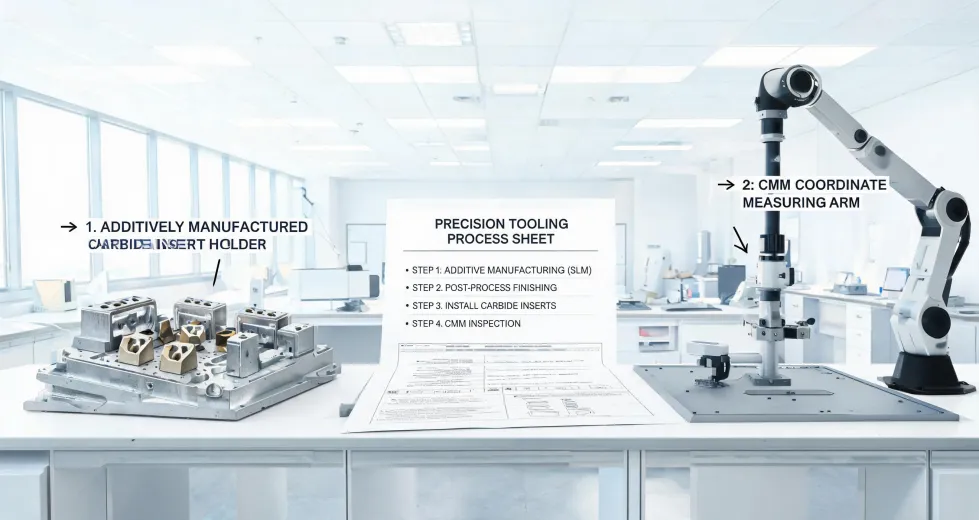
I use additive manufacturing for prototypes and complex internal geometries where a five-axis mill would take too long. But if you need tight tolerance bores, a mirror finish on a bearing seat, or a threaded hole that stays accurate over a production run, you're still going through a cutting tool. Additive is an addition, not a substitute.
What about a desktop laser cutter like the xTool S1?
I get the appeal of a compact laser engraver. The xTool S1 gets good reviews for what it is: a desktop CO2 laser cutter for wood, acrylic, and other light materials. I'm not here to write a full xTool S1 laser cutter product info and reviews post—that belongs on a laser-focused site. But I won't pretend it competes with Tungaloy either.
A laser cutter can mark logos or cut thin sheets. It cannot hold ±0.01 mm on a 3/4-inch bore in cast iron. Different tool, different physics, different quality expectation. If you're gonna buy a desktop laser, buy a desktop laser. If you need to remove metal precisely, buy a cutting tool.
The "fractionated CO2 laser treatment Atlanta" question
I'll close this section with the strangest search phrase that lands on our site every few months: fractionated CO2 laser treatment Atlanta. You're probably looking for a dermatology clinic, not a metal-cutting supplier. This is not that kind of CO2 laser. I don't want to mislead you into thinking a boring bar has anything to do with skin treatment. Honesty has to work both ways.
I'd rather lose that search than pretend relevance. That's the same reason I won't tell a shop that only mills aluminum to buy Tungaloy's heaviest cast-iron inserts—it's not the right fit.
Countering the Obvious Objection: "Isn't This Just 'Right Tool for the Job'?"
It sounds like common sense, but the implication is often missed. Many buyers default to the most expensive tool because they think price equals safety. Others default to the cheapest because they think all inserts are the same. Both are lazy.
My point is not "Tungaloy is premium, so buy premium." My point is that a default has to be defensible. I can defend Tungaloy with inspection data, with repeatability tests, and with the fact that our rework rate dropped after we standardized. That's not marketing logic; it's a quality log.
Still Not "The Best"
So, no, I won't say Tungaloy cutting tools are the best. I'll say they're the safest default for our production environment. That's a stronger statement, because it has evidence behind it. If you need ultra-long tool life on one specific exotic material, or a specialist geometry for one-off threading, maybe another vendor wins that job. That doesn't change the default.
But if you ask me what I'd put on a new machining center in a custom shop tomorrow, it's Tungaloy—unless your process is additive, laser marking, or, well, dermatology.

Ana Kovacevic
Ana Kovacevic is an independent CNC milling and five-axis machining analyst covering precision parts, machining centers, workholding, and complex surface strategies. She applies ISO 1101 geometrical tolerancing while examining datum schemes, tool reach, setup count, spindle load, surface roughness, and inspection access before accepting tight requirements. Her technical guides help design and manufacturing teams improve DFM decisions, compare machine capability, and control dimensional risk from prototype through production.