I Wasted $3,200 on Tungaloy Boring Bars Because I Didn't Read the Catalog
-
My First Mistake: Treating the Tungaloy Catalog Like a Price List
-
September 2022: The Boring Bar Job From Hell
-
A Detour Through the Additive Manufacturing Laboratory
-
The Tungaloy Catalog Isn't a Menu. It's a Manual.
-
VMC vs IMC Aviation: What a Pilot Taught Me About Machining Blind
-
The Checklist That Caught 47 Errors in 18 Months
-
What That $3,200 Actually Cost
The phone buzzed at 9:47 PM. It was the inspection report from the day's production run.
47 pieces. Rejected. Every single one.
Bore geometry out of tolerance. Material, machining time, tooling, overhead: $3,200, straight to the scrap bin.
I remember walking onto the shop floor and staring at those parts, still wrapped in protective film, already dead. They looked perfect. That was the worst part.
I've been a CNC programmer and lead machinist since 2017. In that time, I've personally made and documented four significant mistakes, totaling roughly $12,000 in wasted budget. This was mistake number three: the most expensive, the most humiliating, and the most avoidable.
My First Mistake: Treating the Tungaloy Catalog Like a Price List
When I first started using Tungaloy tools, I assumed the catalog was just a parts menu. Saw a boring bar that covered the diameter range? Fine. Insert size? Check. Price? Acceptable. What else was there to know?
A lot, apparently.
Here's the thing: the Tungaloy catalog isn't a sales brochure. It's a technical manual. Every specification in it — length-to-diameter ratios, recommended cutting speeds, insert geometries, coolant path details — exists because someone in Tungaloy's R&D department tested those numbers. I treated them as decorative filler.
In my first year, I made the classic beginner mistake: wrong insert grade for the material. That one cost me $600. It was embarrassing, but it was a beginner mistake. Four years later, I was still shopping from the catalog instead of reading it. That's what made this one painful.
September 2022: The Boring Bar Job From Hell
We had taken on a job for an aviation parts supplier. A housing component with a 1.25-inch bore, tolerance tighter than anything we'd held for that client. "We've machined similar parts," I said. "No problem."
The job called for a Tungaloy boring bar. I checked the diameter range. It matched. I picked an insert grade for 17-4 PH stainless steel. The catalog listed it as suitable. I set speeds based on what we'd always used.
In theory, everything was right.
In practice, I missed the length-to-diameter ratio.
The bore was six diameters deep. Six diameters. And I had selected a bar that was never designed for that kind of overhang without vibration control. The catalog had the maximum recommended overhang for that bar. It had a chatter risk chart. It even had a note about deflection at depth.
Did I check any of it? No. I watched the first part come out looking clean, felt confident, and ran the batch. On the second piece, I pushed the speed up to hit cycle time. That was my second mistake.
The first part passed inspection. Parts two through forty-seven didn't.
Chatter at depth. Deflection. The bore geometry drifted in and out of tolerance in 0.0003-inch waves. The machine never complained. The chips looked healthy. Nothing screamed "failure" until each part came off the machine and hit the CMM.
And here's the detail that still stings: the Tungaloy catalog was sitting on my bench the whole time. Under my elbow. Open to the section I needed. I had flipped past that deflection chart at least twenty times that week.
All the information I needed was already in the building. I just didn't read it.
A Detour Through the Additive Manufacturing Laboratory
Around the same time, a researcher from the additive manufacturing laboratory at our local university visited the shop. He was working on printed tooling prototypes and wanted to see how we clamped boring bars in production.
I showed him the setup. Then he asked to see the failed parts.
"You're treating the bar as a single component," he said. "At six diameters overhang, it's a system. Deflection isn't just the bar. It's the clamping, the body bending mode, the insert geometry, the workpiece rigidity. You can't fix that by changing the feed rate."
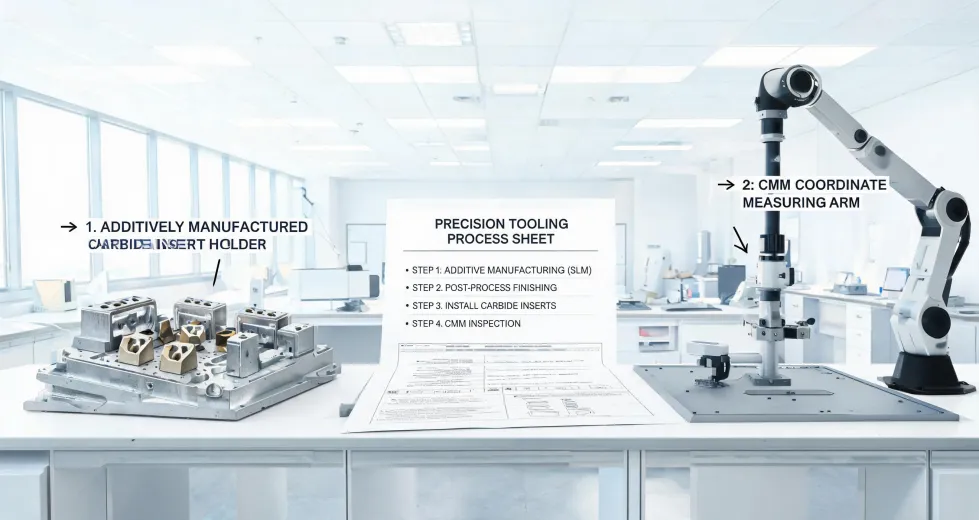
He came back three weeks later with a 3D-printed boring bar body — an experimental design with internal dampening channels, fabricated at the lab (I still have the measuring notes sitting in a drawer; I really should digitize those). It wasn't production-stiff, not even close. But we mounted it in a fixture and watched the deflection happen in real time with a dial indicator. Seeing where the bar bent, how the deflection propagated, taught me more in an hour than I'd learned in five years of cutting chips.
That detour made me face an uncomfortable truth: I had never looked at my production boring bars that closely. I had never asked why the catalog specified certain overhangs, or why Tungaloy offered different bar series for different stiffness classes. I had picked tools like a shopper picking produce. Squeeze it. Looks fine. Put it in the cart.
The Tungaloy Catalog Isn't a Menu. It's a Manual.
So I sat down and read the boring bar section of the Tungaloy catalog. Not skimmed. Read. Page by page.
Most buyers focus on the diameter range and the insert price. They completely miss the length-to-diameter ratio, which is the specification that actually determines whether the part survives. I was one of those buyers. Here's what I finally learned:
- Length-to-diameter ratio is everything. Past 4 diameters, a conventional bar is in chatter territory. Past 5, you need vibration-dampened tooling unless the catalog says otherwise. Tungaloy publishes this for every boring bar. The chart existed before I needed it. I just never looked at it.
- Insert geometry matters as much as grade. The right nose radius and chipbreaker reduce cutting forces enough to dampen chatter at the source. The catalog recommends specific geometries for unstable operations. I had never read that page.
- Recommended speeds and feeds assume ideal rigidity. Here's something tool vendors won't tell you: the moment you deviate from the catalog's assumed conditions — longer overhang, weaker clamping, interrupted cuts — you're on your own. The numbers stop being guarantees and become a starting point. But if you never read the assumptions, you won't know you've left the envelope.
The catalog had been telling me the truth for years. I was the one who never checked the instruments.
VMC vs IMC Aviation: What a Pilot Taught Me About Machining Blind
A few months after the scrap incident, my buddy Dan — an airline pilot — explained something that rearranged my thinking about that failure.
In aviation, the distinction between VMC and IMC is often the difference between living and dying.
VMC is Visual Meteorological Conditions: clear visibility. The pilot can see the horizon and navigate visually. In VMC, experience and instinct work.
IMC is Instrument Meteorological Conditions: low visibility, clouds, fog. The pilot cannot see the horizon. The inner ear — reliable on the ground — starts sending false signals. In IMC, the only way to survive is to trust the instruments, even when the seat of your pants insists everything is fine.
"The rough part," Dan told me, "is that in IMC, the ride can feel completely smooth. Your instincts say you're flying fine. The instruments say otherwise. Pilots who fly by feel in the clouds — even experienced ones — don't tend to catch it in time."
That conversation was a gut punch. Machining a deep bore is IMC, always. You cannot see the cutting edge. You cannot see the chatter starting. You cannot feel the deflection while the machine is running. The part drifts out of tolerance in complete silence, and you only find out at the measuring station.
The Tungaloy catalog is your instrument panel. Every number in it is a gauge reading that tells you what's happening inside that invisible hole — before it costs you $3,200.
The question isn't whether the setup feels right. It's whether the specs say it's right. In IMC, feelings don't count. Instruments do.
The Checklist That Caught 47 Errors in 18 Months
After a third rejection in Q1 2024 — less dramatic, but the same pattern — I finally wrote a pre-order and pre-run checklist. It's mounted on the bench, right next to the catalog.
As of this writing, we've caught 47 potential errors using that checklist. Two of them would have been full-batch scrapped. Not bad for one afternoon of writing.
Here's the list:
- Is the length-to-diameter ratio inside the catalog's recommended range for this bar?
- Does the insert geometry match the finishing requirement, not just the material grade?
- Are the speeds/feeds within the catalog's range for the full depth of cut, not just the first pass?
- Is the coolant direction exactly what the catalog specifies?
- What are the thermal conditions? Is the part stable enough to hold tolerance across the whole run?
- Have we documented this exact setup before? "Similar" doesn't count. "Identical" does.
Number five came from a conversation with my French colleague Lucas. He was researching a thermodynamic ventilation system for his new workshop (the prix vmc thermodynamique rabbit hole, as he called it — French HVAC pricing is apparently a labyrinth). His argument was that you pay for stability: in temperature, in airflow, in consistency. "Your machining center is the same," he said. "You don't just buy a machine. You buy a climate around it." For a boring bar at six diameters overhang, a changing thermal state changes the bore. I added that to the checklist the same day.
What That $3,200 Actually Cost
Here's the part that nobody tells you about shop-floor quality failures: the money burns once, but the credibility burns twice.
The client didn't yell. They just sent the rejection and went quiet. A week later, they sent a smaller order. Then a smaller one after that. They were doing what clients do: pulling back, watching, deciding whether we were the sloppy shop or the reliable one.
Clients receive parts, not explanations. When the parts are wrong, they don't think "bad luck." They think "we can't trust these people." Quality is brand image. Every good batch is invisible; every bad batch is unforgettable.
That $3,200 was the cost of the scrap. The real cost was the year of quiet suspicion I had to machine my way out of.
So if you're a machinist who's made this mistake — or is about to — hear me out. Read the catalog. All of it. Follow the checklist. When the bore is deep and the job is tight, remember you're flying IMC, and your instruments are the specs you chose to ignore.
That's the lesson. I just wish it hadn't cost me $3,200 to learn it.

Ana Kovacevic
Ana Kovacevic is an independent CNC milling and five-axis machining analyst covering precision parts, machining centers, workholding, and complex surface strategies. She applies ISO 1101 geometrical tolerancing while examining datum schemes, tool reach, setup count, spindle load, surface roughness, and inspection access before accepting tight requirements. Her technical guides help design and manufacturing teams improve DFM decisions, compare machine capability, and control dimensional risk from prototype through production.