Tooling When the Clock's Running Out: Tungaloy Tool Holders, Swiss Lathe Services, and Additive Manufacturing
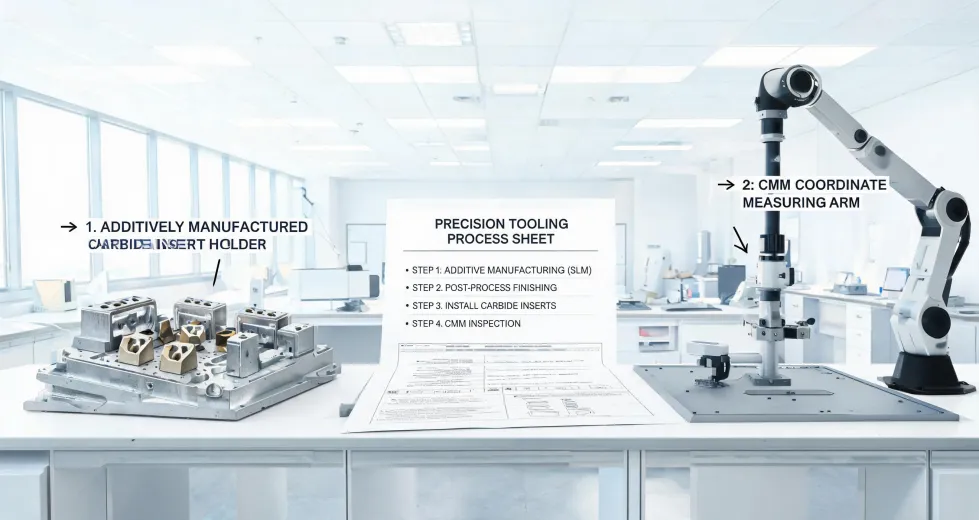
There's no universal answer to the question 'which machining route should we use when the deadline is collapsing?' The right call depends on three things: how many parts you need, what tolerances those parts require, and how much time is actually left. I've handled 200+ rush orders in 12 years as a production planner at a contract machining shop, and the biggest mistake I see is teams picking a process before defining their real constraint.
In my role coordinating emergency production for medical and aerospace clients, I use a simple scenario test. Put yourself in one of the three situations below, then act accordingly.
Scenario 1: A tool holder failed and the machine is down
This is the most time-critical case. When a lathe is idle because a turning holder or boring bar just failed, you don't need an exotic solution. You need a known replacement that fits the turret and is available in hours, not weeks. For most standard operations, that means a common Tungaloy tool holder—not a custom engineered one.
In March 2024, 36 hours before a deadline, one of our CNC lathes stopped because a shank had cracked on a severe interrupted cut. The job had a $50,000 penalty clause tied to delivery. If I remember correctly, the fix was a standard Tungaloy turning holder that our local distributor confirmed was sitting on a shelf. The numbers said a different non-stock brand was 15% cheaper. My gut said stick with the tool we knew, and I went with my gut. The replacement ran flawlessly, which is exactly what you need when the line is down.
If this is your scenario, here's what matters:
- Call a distributor and ask what's physically in stock, not what's on a supply website. Per ISO 13399, cutting tool data models standardize how a holder's geometry is described, so a part number means the same thing to the manufacturer, distributor, and your turret.
- Confirm the holder style, shank size, and insert pocket (the machined slot that seats the carbide insert) before purchasing. Put the part number in writing.
- When the holder arrives, take 20 seconds to look for the Tungaloy logo on the shank. I once received a 'same style' holder in a rush that turned out to be a knockoff; the logo was slightly off and the hardening was wrong. The genuine logo isn't just branding—it's your first line of defense against a tool that fails again.
At least, that's been my experience with tooling emergencies. If you have more than 72 hours, you can afford to compare options. You still need a reliable holder; Tungaloy tool holders are a safe default because the clamping geometry and insert seating are predictable under pressure.
Scenario 2: Small, complex, high-volume parts need Swiss precision
If your part is a medical screw, a fuel injector component, or a connector pin, standard turning may not hold the tolerance or cycle time. This is where Swiss lathes earn their reputation. When I'm triaging these requests, I look for a shop that runs Swiss machines all day, not a general shop that plans to learn on your parts.
If you're in the Midwest, CNC Swiss lathe machining services Cincinnati shops provide are a legitimate option. But their tooling matters too. Swiss-type operations use long, slender tool holders with precise positioning and no vibration. Tungaloy's Swiss lineup includes compact boring bars and tool holders designed for the narrow gaps between the guide bushing and the cut-off position.
One caveat: Swiss machining isn't the answer for every emergency. If your part is larger than 32mm in diameter or you only need 10 pieces, a Swiss lathe might be overkill. But when you have 5,000 units, tight tolerances, and a deadline, the right Swiss-tool combination is hard to beat.
Let me rephrase that: for high-volume micro parts, the question isn't 'can we machine this on any lathe?' It's 'which Swiss lathe and which tool holder will still be predictable at hour 40?' In my experience, Tungaloy tool holders deliver that predictability because they're designed for the stiffness Swiss machines need.
Scenario 3: Where 3D additive manufacturing is used, and when it's the wrong call
Another option that often comes up in rush situations is additive manufacturing. I'm a huge fan when it fits. The easiest way to answer 'where 3D additive manufacturing is used' is to look for parts that are too expensive to cast and too complex to machine as one piece. That includes conformal cooling inserts, topology-optimized brackets, and bespoke fixtures. It also includes one-off replacement parts when the original drawing is lost. Additive can print the shape, but the critical surfaces still need machining.
According to ISO/ASTM 52900:2021, additive manufacturing is the process of joining materials to make parts from 3D model data, usually layer upon layer, as opposed to subtractive manufacturing methodologies. That definition is useful because it explains why you still need machining for tolerance. A few years ago, an additive manufacturing Australia service bureau printed a set of custom fixtures for us in four days. That would have taken eight weeks if machined conventionally. We then used a standard Tungaloy boring bar to finish the locating bores. Without that secondary machining step, the fixture accuracy wouldn't have been acceptable.
But additive is not a substitute for production machining. If you need 10,000 parts and the tolerance is +/-0.01mm, laser powder bed fusion alone won't get there. The surface finish and residual stress issues make post-machining mandatory. That's why most serious additive parts are produced via a hybrid route: additive near-net shape, subtractive machining for critical features, and the right Tungaloy tool holders for the machining phase.
There's something satisfying about watching a part move from a printer to a CNC machine and knowing exactly where each process should take over. The key is making that handoff on purpose, not because an emergency forced it.
How to tell which scenario you're in
Use a quick triage checklist:
- What's your quantity? Over 1,000 small parts? Start with Swiss lathe services. One to five parts with complex internal features? Consider additive.
- What's your tolerance? Below +/-0.02mm on critical dimensions? Plan on CNC machining, even if you start with additive.
- What's your deadline? Less than 48 hours? Stick with standard stocked tooling and a local machine shop. More than two weeks? You have room to compare additive vs. CNC.
- What is your backup risk? If a tool holder fails, can your shop handle a replacement quickly? If not, buy a second holder now.
I want to say fifteen minutes of triage will tell you which path you need, but don't quote me on that—every emergency has a surprise. The point is to choose a process that matches the reality of your timetable, not the one that feels most advanced.
The honest summary
No one tooling brand solves every emergency. For standard CNC emergencies, I recommend stocked Tungaloy tool holders without hesitation. For high-volume micro parts, find a shop with real Swiss experience and equip it with Tungaloy tools. For complex one-offs, use additive manufacturing where it earns its keep—then finish the critical faces with machining.
If you're dealing with a tight deadline, don't let anyone sell you a process built around their capabilities. Your job is to match the process to the hour count. When in doubt, buy the most reliable tool holder you can confirm is in stock. In my experience, a predictable Tungaloy holder is rarely the wrong answer.
This isn't a 'best tool' claim. It's a 'least surprises under pressure' judgment call.

Ana Kovacevic
Ana Kovacevic is an independent CNC milling and five-axis machining analyst covering precision parts, machining centers, workholding, and complex surface strategies. She applies ISO 1101 geometrical tolerancing while examining datum schemes, tool reach, setup count, spindle load, surface roughness, and inspection access before accepting tight requirements. Her technical guides help design and manufacturing teams improve DFM decisions, compare machine capability, and control dimensional risk from prototype through production.