CNC vs Injection Molding vs Additive Manufacturing Platform: A Buyer's View on Tungaloy Turning and Boring Bar Tips
I'm an office administrator for a 120-person manufacturing company. I manage all custom metal and plastic part ordering—roughly $450,000 annually across 18 vendors. I report to both operations and finance, so my job is part logistics, part risk management. Trust me on this one: the manufacturing process decision is not just a shop-floor question. It's a purchasing decision, too.
Today I'm comparing three options: CNC machining, injection molding, and an additive manufacturing platform. In each dimension I'll put them side by side, because the differences only matter when you see them together.
The Comparison Framework
Here's what you need to know first: every part request is a tradeoff between tooling, piece price, lead time, and design freedom. In my experience, people argue about CNC vs injection molding without defining which dimension they care about. I'm going to use four dimensions:
- Cost structure (tooling vs unit price)
- Lead time
- Material properties and tolerances
- Design flexibility and scalability
The bottom line up front: none of these is universally better. In some cases, CNC beats injection molding even at 2,000 pieces. In others, injection molding wins at 200. And additive can surprise you in either direction.
Cost Structure: Tooling vs Piece Price
First, let's talk about money. The biggest mistake in comparing processes is looking at per-part cost without including the mold. So let's not do that.
Injection molding has a tooling cost. A simple mold can run $5,000-$20,000; a complex multi-cavity mold can run $50,000 or more. That cost gets amortized across the entire run, which is why injection molding makes sense at high volumes. CNC machining has minimal upfront tooling, but higher variable costs per part. An additive manufacturing platform has no mold, and the per-part cost tends to be high, especially in metal.
People think injection molding is cheaper for high volumes because the per-part price is low. Actually, that low per-part price only exists because you already paid for the mold. The causation runs through tooling amortization, not volume magic.
In Q3 2024, I collected quotes from four suppliers for an aluminum bracket. CNC was $22 per part with a zero setup fee. Injection molding was $8 per part, but included a $14,500 mold fee and a minimum order of 1,000 pieces. The crossover point was around 1,035 parts. For 800 pieces, CNC was the no-brainer; for 5,000 pieces, injection molding would have won comfortably.
Lead Time: Waiting on a Mold vs Waiting on Post-Processing
Lead time is where assumptions get dangerous.
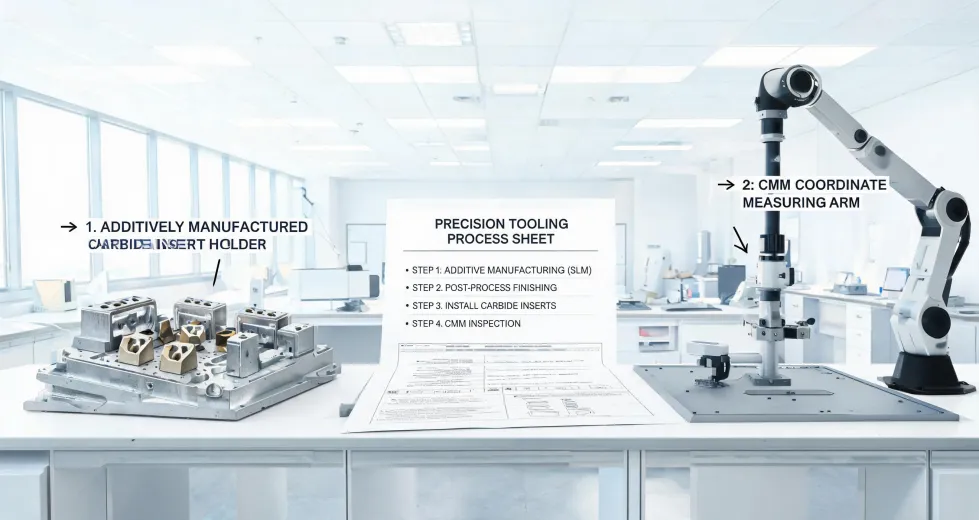
CNC usually needs 1-2 weeks for a typical job once the material is on hand, depending on machine capacity and finish requirements. Injection molding needs 4-12 weeks for tooling, then first articles, then samples. Additive can hand you a part in a day or two, but that doesn't count the hours of support removal, heat treatment, machining of critical faces, or inspection.
The assumption is that additive is always fastest. The reality is that CNC is often faster for a run of 10-50 metal parts, because the post-processing on an additive manufacturing platform can easily eat a week. For a one-off prototype, additive wins. For a short batch, CNC is usually faster.
I went back and forth on this earlier this year. A customer needed 60 stainless steel fittings. Additive quoted 5 days for the build plus 4 days of post-processing. CNC quoted 12 days from material stock to delivery. The difference was close, but CNC had the edge on surface finish in the bore. The upside was a 20% cost saving; the risk was a two-week delivery slip. I kept asking myself: is that worth the face time with my VP? I still feel good about that call.
Material Properties and Tolerances
If you've ever looked at a machined part and a printed part next to each other, you know the finish difference is hard to argue with. CNC machining gives you near-net geometry and tight tolerances. With the right Tungaloy turning tools on a lathe, I've seen diameters held within a few microns. That matters for shafts, housings, and internal bores.
Boring bar tips matter more than most buyers realize. Cheap inserts can chatter, deflect, and ruin the surface finish on an internal diameter. A quality Tungaloy boring bar with the right insert geometry (meaning the right nose radius and chipbreaker) is what separates a passable bore from a reliable one. According to Tungaloy's application engineering guides, insert selection is one of the first variables to check when troubleshooting bore finish. If you're getting CNC quotes, ask about their cutting tool brands and insert grades. That's not a vanity question—it affects scrap rate.
Injection molding can hold tolerances around +/-0.1 mm with good process control, but it's limited to thermoplastics and sometimes liquid silicone rubber. You can't mold a 60 HRC steel shaft. Additive manufacturing platforms can produce metals like titanium and Inconel, but they have their own issues: residual stress, anisotropy, and roughness that often requires finish machining.
So if your part is a metal component with tight internal geometry, CNC remains the most reliable platform. If you need a plastic housing with cosmetic requirements, injection molding is the standard. If you need a complex internal lattice in a superalloy, additive earns its keep.
Design Flexibility and Scalability
This is where the small-customer friendly angle comes in. The way I see it, small-volume orders deserve real options, and both CNC and additive respect that.
A mold is a designed-in commitment. Once you cut steel, every design change costs money. I still kick myself for approving a mold before the design was fully frozen. The customer changed a mounting boss, and we paid $3,800 for a mold modification. If I'd insisted on a CNC sample run first, we'd have caught that issue for $400.
CNC and additive are far more forgiving. A new program or a new file is all you need to change. That's why I tend to use CNC and additive for early-stage products and injection molding for mature, stable designs. Scalability is also different: injection molding is the game-changer at high volume because the per-part cost drops and cycle times are seconds, not minutes. But the scalable product doesn't exist until the product design is stable.
Here's a useful question to ask any injection molding supplier: what is your minimum quantity for a first order? If the answer is 5,000 parts and they won't discuss a pilot run, treat that as a red flag—especially if you're a smaller company. In my opinion, a supplier who ignores a $500 order isn't a supplier; they're someone who thinks your future doesn't matter.
So glad I pushed back on that. Almost went straight to injection molding because the quote looked attractive. It would have been the expensive mistake.
So Which Manufacturing Platform Should You Choose?
Personally, I don't like 'always' advice. Here's my ballpark set of rules based on years of purchase orders:
- 1-10 parts, complex geometry, metal or plastic: additive manufacturing platform is your friend. You're prototyping, not producing.
- 10-500 parts, metal, tight tolerances: CNC machining, especially with good Tungaloy turning and boring bar tips. No tooling commitment, fast turnaround, and small-order-friendly suppliers will treat you reasonably.
- 500-5,000 parts, stable design, metal or plastic: compare CNC vs injection molding carefully. The crossover depends on mold cost, piece price, and your cash flow. Most of the time, CNC is still competitive at the lower end of this range.
- 5,000+ parts, plastic, mature design: injection molding is hard to beat. Just make sure the mold cost is amortized across a realistic volume and design is frozen.
From my perspective, the real enemy is locking yourself into a process before you understand the demand curve. If you're on the fence, get quotes for all three options. Most reputable CNC shops and additive service bureaus will give you a quote based on your CAD file. Ask the injection molding shop for a mold cost and a piece price, not just a per-piece number.
The bottom line: use an additive manufacturing platform to iterate, CNC to produce quality metal parts with confidence, and injection molding to scale a stable plastic design. And if a supplier sneers at your small order, move on. Today's small run is often tomorrow's production run—take it from someone who has placed both.

Ana Kovacevic
Ana Kovacevic is an independent CNC milling and five-axis machining analyst covering precision parts, machining centers, workholding, and complex surface strategies. She applies ISO 1101 geometrical tolerancing while examining datum schemes, tool reach, setup count, spindle load, surface roughness, and inspection access before accepting tight requirements. Her technical guides help design and manufacturing teams improve DFM decisions, compare machine capability, and control dimensional risk from prototype through production.