Why Your Cutting Tools Underperform (It's Probably Not the Tool)
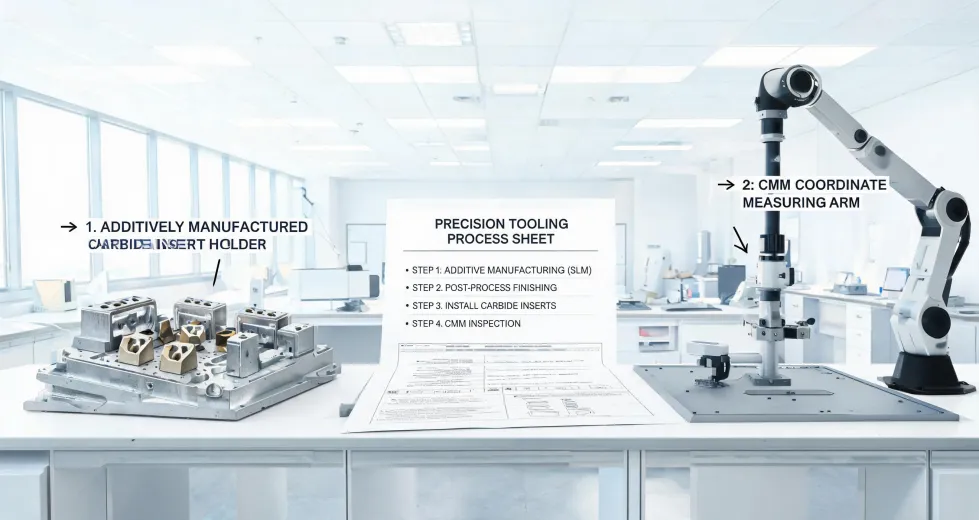
Six years ago, when I took over purchasing for a 60-person precision machining shop, I didn't know much about cutting tools. I'd been an office administrator—the person who ordered laptops and coffee and made sure the invoices got paid. But when the previous buyer left, the job landed on my desk, and I learned fast. Today I manage about $400,000 a year in tooling spend across fifteen vendors. I report to operations and finance, which mostly means I get blamed from both directions when something goes wrong.
What I learned in those six years is probably not what the cutting tool brochures would lead you to believe. I'm sharing it because I wish someone had told me—loudly and early—that the tool is not the whole story.
The surface problem: tools that die before they should
Our shop was burning through indexable inserts at a rate that made no sense. Same part numbers, same materials, same CNC programs—but tool life swung by 30-40% between batches. The machinists said we were buying inferior tools; finance said we were spending too much on replacements. I assumed they were both right, so I did what any overwhelmed buyer would do: I upgraded to a premium brand. I standardized on Tungaloy cutting tools across our turning and milling operations.
And the problem... stayed. Not entirely—the Tungaloy inserts were better, maybe 10-15% better on average. But the inconsistency didn't disappear. Some batches lasted fine, others failed early, and we still couldn't predict which job would be the problem.
The surprise wasn't the quality of the inserts. It was how much hidden value came from parts of the system I'd never given a second thought.
The first real culprit: tool holders
Everything I'd read about tool performance focused on insert grades, chip geometries, and coatings. The conventional wisdom is that the insert does the cutting, so the insert is what matters. My experience with a few hundred tool orders suggests otherwise.
A tool holder determines rigidity, runout, and repeatability. If the holder flexes even a few microns under load, the insert vibrates, the edge micro-chips, and tool life collapses. But nobody talks about the holder much, because the marketing budget follows the flashy stuff—new grades, new coatings, new chipbreakers.
This hit home when I finally ran a quiet side-by-side test. Same Tungaloy insert. Three different holders: a no-name import we'd picked up years ago, a mid-tier domestic brand, and a Tungaloy tool holder. Same CNC machine, same material, same program. I wanted to settle, once and for all, whether the holder actually mattered or whether we were all just buying into tool snobbery.
What the test showed
When I compared the wear patterns side by side, I finally understood why the details matter so much. The cheap holder gave us roughly half the edge life of the Tungaloy holder. Half. The mid-tier came in at maybe 70%. Same insert in every case—the only difference was what was holding it.
In my opinion, most small shops are leaving tool life on the floor because they pair good inserts with mediocre holders. They blame the insert when the real problem is flex, runout, or a worn-out clamping mechanism. That one lesson has saved us more money than any brand upgrade we've ever made.
The second culprit: advanced claims don't survive real work
Around the same time, our shop got pitched on surface treating tool holders. A vendor claimed that CO2 laser treatment results in significantly harder, longer-wearing mounting surfaces. That sounded great—and a little too convenient. Per FTC guidelines (ftc.gov), marketing claims have to be truthful and substantiated, and I'd argue the tooling industry stretches that standard pretty regularly.
So we tested it. The CO2 laser treatment results on our tool holders? Mixed. On short production runs, no measurable difference from untreated holders. On one longer run, maybe 10% better wear on the locating surfaces—which, honestly, is within batch noise. The claim wasn't false. It was overstated relative to real-world conditions.
The lesson stuck with me: verify, don't trust. The cost of skepticism is a little time. The cost of adopting based on a glossy data sheet is much higher.
Process knowledge changes what you buy
Part of maturing as a buyer was learning how the tools I was buying fit into broader manufacturing processes. That started when we began prototyping with laser tube cutting for machine frames and conveyor guards. I found our first supplier by literally searching 'laser tube cutting Blaine'—there's a fabricator cluster near Blaine, Minnesota, and I had no idea until that moment.
Watching tube lasers work taught me something that applies to cutting tools too: the machine is maybe 40% of the result. The material batch, the assist gas, the parameter setup, the operator's experience—all of it matters more than the brand of the machine. It's a systems problem, not a component problem.
Then came 3D printing. Our engineers kept asking for faster fixtures, and I kept hearing the question 'what are the two types of 3d printers?' from colleagues who'd never used one. The basic answer:
- FDM (Fused Deposition Modeling)—the ones that melt plastic filament and lay it down layer by layer. Fast, cheap, forgiving. Great for rough fixtures, layout aids, and prototype brackets.
- SLA (Stereolithography)—the ones that cure liquid resin with a UV laser. Slower, more expensive, but accurate enough for detailed parts like alignment guides and custom gauges.
Neither replaces machining, and I'm not here to pretend 3D printing is a cutting tool competitor. But both have saved us weeks of lead time, and they've sharpened my thinking: know the real capability and limitation of each process, and pick accordingly.
An informed customer asks better questions and makes faster decisions. I'd rather spend 10 minutes explaining options than deal with mismatched expectations later.
The actual cost of ignoring all this
During the six months before we fixed our holder situation, tool failures cost us in painfully concrete ways:
- A single failed finishing pass on an aluminum housing costs about $150 in material plus $85/hour in machine time. At that rate, even one extra failure per week is a $12,000 annual hit.
- A week of unpredictable tool failures drove one job to a 4% scrap rate. Four percent doesn't sound dire until it's $28,000 in scrapped parts. We have three jobs running at any given time.
- Late deliveries from that period cost us a repeat customer. They moved that contract to a shop with a better delivery record—and I can't argue with their logic.
The most frustrating part is that all of it was avoidable. You'd think someone would have said early on: 'check your holders before you blame the inserts.' But the industry is built around selling inserts, not holding systems, so that advice waits until you've already lost the money.
What actually worked for us
I'll keep this short, since the problem part is the part that matters. But for the record, in order of impact:
- Standardized on Tungaloy tool holders. Replacing mismatched and worn-out holders eliminated the runout and flex that were killing edge life.
- Matching the tools to the holders. Tungaloy cutting tools mounted in Tungaloy holders performed measurably better than mixed-brand setups in our tests. Not magic, but consistent.
- Verified every technical claim. CO2 laser-treated holder? Tested. New coating? Tested. Everything gets a trial before it gets a purchase order.
- Factored in the logistics. Even shipping adds up. Small inserts fit in a USPS First-Class large envelope—$1.50 as of January 2025 (usps.com/stamps)—so we consolidated orders to make the most of flat-rate shipping rather than letting small orders accumulate overnight fees.
That last one seems minor, but when you're ordering tooling every week, the logistics cost is part of the total cost of ownership. It's the same mindset that made us check the tool holder in the first place: look at the whole system, not just the shiny part.
I'm writing this for the next person who's about to blame the insert and doesn't realize the holder might be the problem. It took me years to figure that out. Maybe this saves you one.

Ana Kovacevic
Ana Kovacevic is an independent CNC milling and five-axis machining analyst covering precision parts, machining centers, workholding, and complex surface strategies. She applies ISO 1101 geometrical tolerancing while examining datum schemes, tool reach, setup count, spindle load, surface roughness, and inspection access before accepting tight requirements. Her technical guides help design and manufacturing teams improve DFM decisions, compare machine capability, and control dimensional risk from prototype through production.